Continuous Training Course
Course information
CPR accredited continuous training courses
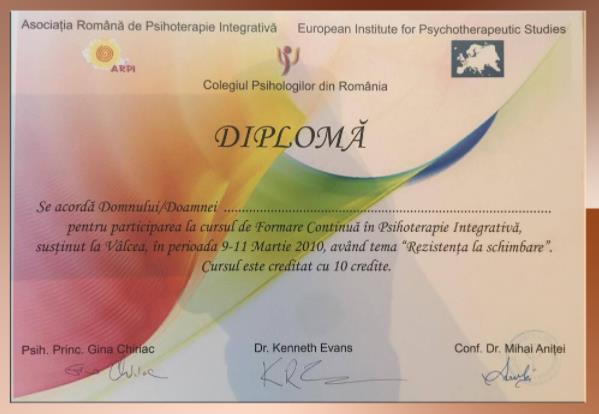
Resistance to change, 30 hours – 10 credits
Emotional intelligence, behavior in life and success, 30 hours – 10 credits
Shame – the hidden emotion or the conductor of life, 30 hours – 15 credits
From objective reality to each person's reality. Quantum Integrative Psychotherapy, 50 hours – 50 credits
Interdisciplinary approach to illicit drug use. Specific intervention techniques of integrative psychotherapy, 30 hours – 30 credits
Price: It is determined based on the specifics of each course.
Trainers: Principal Psychologist Gina Chiriac, MA Angela Carr, MA Joanna Kato, MA Joanna Hewitt-Evans, Constantin Cojocaru, Dr. Aurelia Moraru
If there is demand, they can be organized in any city in Romania.
For more details, please contact us at the phone number 0720.010.844 or at the email address
WHAT IS CONTINUOUS TRAINING?
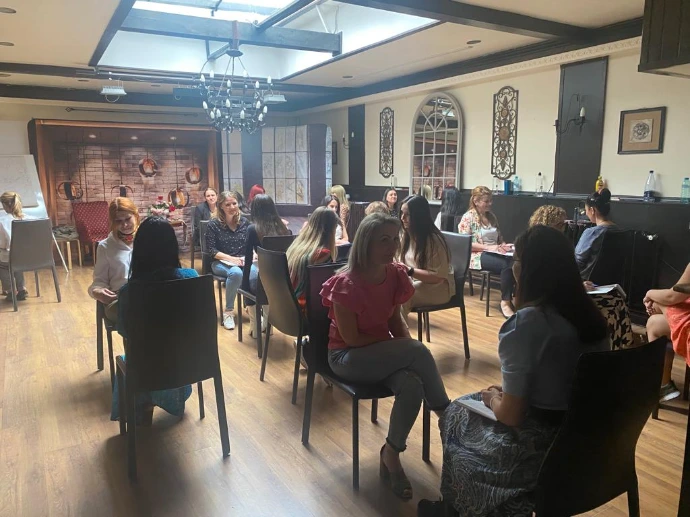
Continuous training courses represent an important stage in the professional path of psychologists with the right to practice freely.
According to the legislation in the field, the professional training of psychologists with the right to practice freely is carried out through initial professional training (bachelor's studies), complementary specialization professional training (master's studies or training accredited by the College of Psychologists), and continuous professional training for obtaining and developing specific professional competencies.
WHO IS IT ADDRESSED TO?
Psychologists, psychotherapists, and counselors who wish to participate in the continuous training program.
The conditions for participation in the training program are in accordance with national and European regulations.
THE TOPICS OF THE CONTINUOUS TRAINING COURSES OFFERED BY ARPI
- Communication and therapy, 30 hours – 10 credits
- Resistance to change, 30 hours – 10 credits
- Emotional intelligence, behavior in life, and success, 30 hours – 10 credits
- “Shame – the hidden emotion or the conductor of life,” 30 hours – 15 credits
- “From objective reality to each person's reality. Quantum integrative psychotherapy,” 50 hours – 20 credits
- “The interdisciplinary approach to illicit drug use. Specific intervention techniques of integrative psychotherapy,” 30 credits
Description of the continuing education stage
1. Continuing education takes place over 200 hours + 25 hours (theoretical supervision) and will be achieved through participation in accredited modules recognized as continuing education, participation in congresses and conferences, participation in the training process by working with participants in basic training, participation through supervision especially in working pairs, cartels, and groups, and participation in an internship of at least 25 hours with a senior supervisor.
2. Supervisor training (50 hours + 25 hours) will be conducted through participation in practical and theoretical training activities.
2.1 The theoretical part will include concepts about evaluation criteria as a central element of the supervisor's responsibility, as well as criteria for evaluating competence as follows:
- The supervisee is the creator of a coherent working framework in which theory is applied relevantly to clinical practice;
- How the supervisee conceptualizes the stages of therapy and future directions in therapy;
- Observing whether the intervention is sprinkled with ethical dilemmas and role overlaps;
- The skills of the supervisor: flexibility, multi-perspective vision, awareness, patience, impartiality, and the ability to understand;
- Developing a personal supervisory style in integrative psychotherapy;
- Ethical decisions in supervision, transparency, and authenticity
- The skills of the supervisor: flexibility, multi-perspective vision, awareness, patience, impartiality, and the ability to understand;
- Developing a personal supervisory style in integrative psychotherapy;
- Ethical decisions in supervision, transparency, and authenticity
TYPES OF SUPERVISION
- Individual;
- Group supervision;
- Supervision through participation in the training process;
- Supervision through audio, video means;
2.2. At least 25 hours of supervision with a senior supervisor.
Continuous training takes place annually and you can earn 10 credits for each of the modules described above.
What diplomas are obtained?
Upon completion of the courses, diplomas with credits are obtained, approved by the College of Psychologists in Romania, respectively the supervision diploma in the case of completing the supervision courses.