SPECIALIZATION: PSYCHOTHERAPY FOR CHILDREN AND ADOLESCENTS
COURSE INFORMATION
- Duration of specialization: 6 months
- Structure: 4 online modules and 1 live camp of 6 days/year
- Start date of specialization: September 17 – 18, 2022
- Camp duration: May 29 – June 03, 2023.
- Final exam date: June 03, 2023.
- Module price: 145 euros/module
- Camp price: 600 euros/live camp
Modules take place on weekends, Saturday and Sunday, and the camp according to the above calendar.
BENEFITS:
- Certificate of free practice – practicing psychotherapist psychologist under supervision
- European Certificate of Integrative Psychotherapist
The structure of the specialization is:
- Specialization stage 1: 4 online modules
- Specialization stage 2: 1 live camp of 6 days/year
Trainers: Dr. Gina Chiriac, MA Joanna Hewitt-Evans, MA Joanna Kato, Dr. Ioan Andronic, Dr. Coralina Chiriac, Dr. Dana Porumbu, Dr. Eugen Avram, Psych. Adrian Beu, Psych. Stefan Cepoi, Psych. Carmen Clenciu, Psych. Erna Constantin, Psych. Beatrice Levitchi, Psych. Andreea Neagu, Dr. Elisabeta Nita, Psych. Aurora Popescu, Psych. Simona Preda, Dr. Armand Veleanovici
For more details, please contact us at the phone number 0720.010.844 or at the email address secretariat@psihoterapieintegrativa.ro

THE TOPICS OF THE MODULES IN THE BASIC TRAINING
- Introduction to integrative psychotherapy. Theoretical considerations and their integration into practice
- Stages of human development in the integrative approach. Attachment
- Developmental needs. The theoretical foundation of the relationship in contact (Ken Evans, Eric Berne, Richard Erskine, John Bowlby). The formation of relationships and stages of human development
- Integration of clinical psychology elements and CBT techniques
- Integration of transactional analysis elements
- Unconscious processes. Types of transference
- Integration of Gestalt therapy elements
- Integrative applications. Intrapersonal space: from Ericksonian hypnosis to mindfulness techniques
- The empty chair technique – Comparative study between the English and American schools
- Shadow, Archetypes and Ritual in integrative psychotherapy. Rewriting the personal story and rediscovering the self
- Integration of psycho-somatic therapy elements
- Applied research, experimental designs in integrative psychotherapy
- Relational body psychotherapy
- Integration of psychotherapies
- Applications of integrative psychotherapy
WHAT IS THE BASIC TRAINING IN INTEGRATIVE PSYCHOTHERAPY?
Basic training is a professional training program for those who wish to practice the profession of integrative psychotherapist.
Every licensed psychotherapist in Romania has training in a specific form of psychotherapy.
The national legislation regulating the profession of psychotherapist (Psychologist Law – 213/2004) stipulates the obligation to undergo training in a specific psychotherapeutic approach in order to practice.
Additionally, the personal development stage (150 hours) required for completing the basic training is part of the ARPI offer and is undertaken concurrently with the theoretical training courses.
In personal development, a stage that precedes basic training, students from the universities mentioned in Law 213/2014 can enroll, according to the College of Psychologists in Romania. Personal development is a mandatory stage. Graduates of the aforementioned faculties can enroll in basic training only after obtaining their degree.
Programul de formare ARPI este acreditat de Colegiul Psihologilor din România, se desfașoară sub egida Asociației Europene de Psihoterapie și este în acord cu standardele formative E.A.I.P. (European Association of Integrative Psychotherapy).
Romanian legislation in force stipulates that access to the profession of psychotherapist at the supervised level is only possible after a minimum of two years from the year of obtaining the license in the fields agreed upon by law 213/2004.
WHO IS IT ADDRESSED TO?
The basic training course is aimed at all those who wish to become integrative psychotherapists.
According to the law, the following categories can undergo training in psychotherapy and subsequently practice as accredited psychotherapists by the College of Psychologists:
- Graduates in psychology
- Holders of a bachelor's degree equivalent to: philosophy, philosophy-history, or in the field of social-human sciences (graduates up to the year 1990)
- Graduates in sociology, special psycho-pedagogy, and psychology under the conditions of double specialization (starting from the year 1991)
- Graduates in medicine, social work, and theology
STRUCTURE OF ONLINE BASIC TRAINING COURSES
The basic theoretical training is carried out over a 500 hours and has the following OBJECTIVES:
- Acquisition of basic theoretical formative knowledge through the study of psychotherapy techniques
- Practical applications carried out to acquire the necessary skills in psychotherapeutic practice
- Acquisition of notions of ethics and deontology, and the legislative aspects necessary for psychotherapeutic practice.
The personal development stage of 150 hours required for completing the basic training is part of the ARPI offer and is undertaken concurrently with the theoretical training courses.
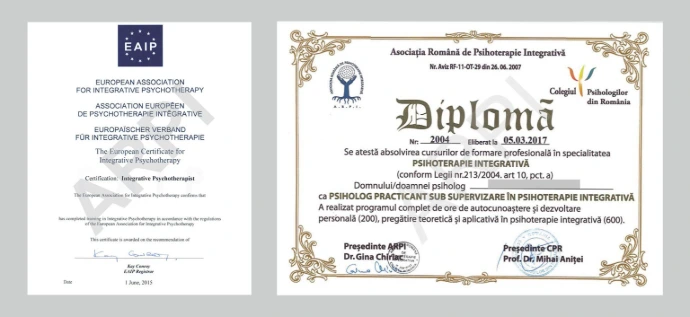
What diplomas are obtained?
Upon completion of the courses, students receive:
- Certificate of free practice in integrative psychotherapy
- European Certificate of Integrative Psychotherapist
Registration and admission
Admission is based on the registration file and the interview that will take place after sending the personal file via email to the secretariat.
The registration filewill include the following documents:
– application for registration (requested via email to the ARPI secretariat)
– copy of the identity card;
– copy of the birth certificate;
– copy of the bachelor's degree or certificate from the university;
– CV;
– copy of documents certifying participation in other training in psychotherapy, personal development groups (if you have participated in other courses/training);
– 2 passport-sized photos.
The interviewwill take place after the submission of the registration file, and the exact date and time will be communicated to each eligible participant.
During the interview, the following are assessed:
– the ability to relate to oneself, to others, and to the group
– self-esteem and self-confidence
– the ability to pay attention, analyze, and synthesize specific to the practice of the profession of psychotherapist
– degree of empathy and social intelligence
– motivation to become a psychotherapist
– degree of mental health
– communication and active listening skills
– level of personal development
In preparation for the admission interview, you may consider the following benchmarks:
– details regarding your educational journey so far
– the motivation for enrolling in the ARPI training program
– what expectations you have from the psychotherapy training within ARPI
– what objectives you pursue in the integrative psychotherapy training process
– your most significant successes and failures
– the emotional difficulties you are facing or have faced in the past
– any psychological or psychopathological issues for which you have received treatment or for which you have been hospitalized
– the motivation for wanting to train as an integrative psychotherapist
– qualities, traits, concerns that you have and that you consider useful for your therapeutic training process,
– what books or video materials related to the subject of psychotherapy you particularly enjoyed
– what “being a psychotherapist” means to you, how you envision working as a therapist after completing your training.
The IESTCA course specializing in child and adolescent psychotherapy is nationally accredited by the Romanian College of Psychologists and European accredited by the European Multidisciplinary Association for Therapy with Children and Young People.
Graduates of the specialization course obtain a Certificate of free practice (certificate in Integrative Psychology (CPR) and European Certificate of psychotherapist in child and adolescent therapy, issued by the European Interdisciplinary Association for Therapy with Child and Young People (EIATCYP)
REGISTRATION AND ADMISSION
Admission is based on the registration file.
The registration file will include the following documents:
- registration request (requested via email to the ARPI secretariat)
- copy of the identity card;
- copy of the birth certificate;
- copy of the free practice certificate;
- CV;
- copy of documents certifying participation in other psychotherapy training, personal development groups (if you have participated in other courses/training);
- 2 ID photos.